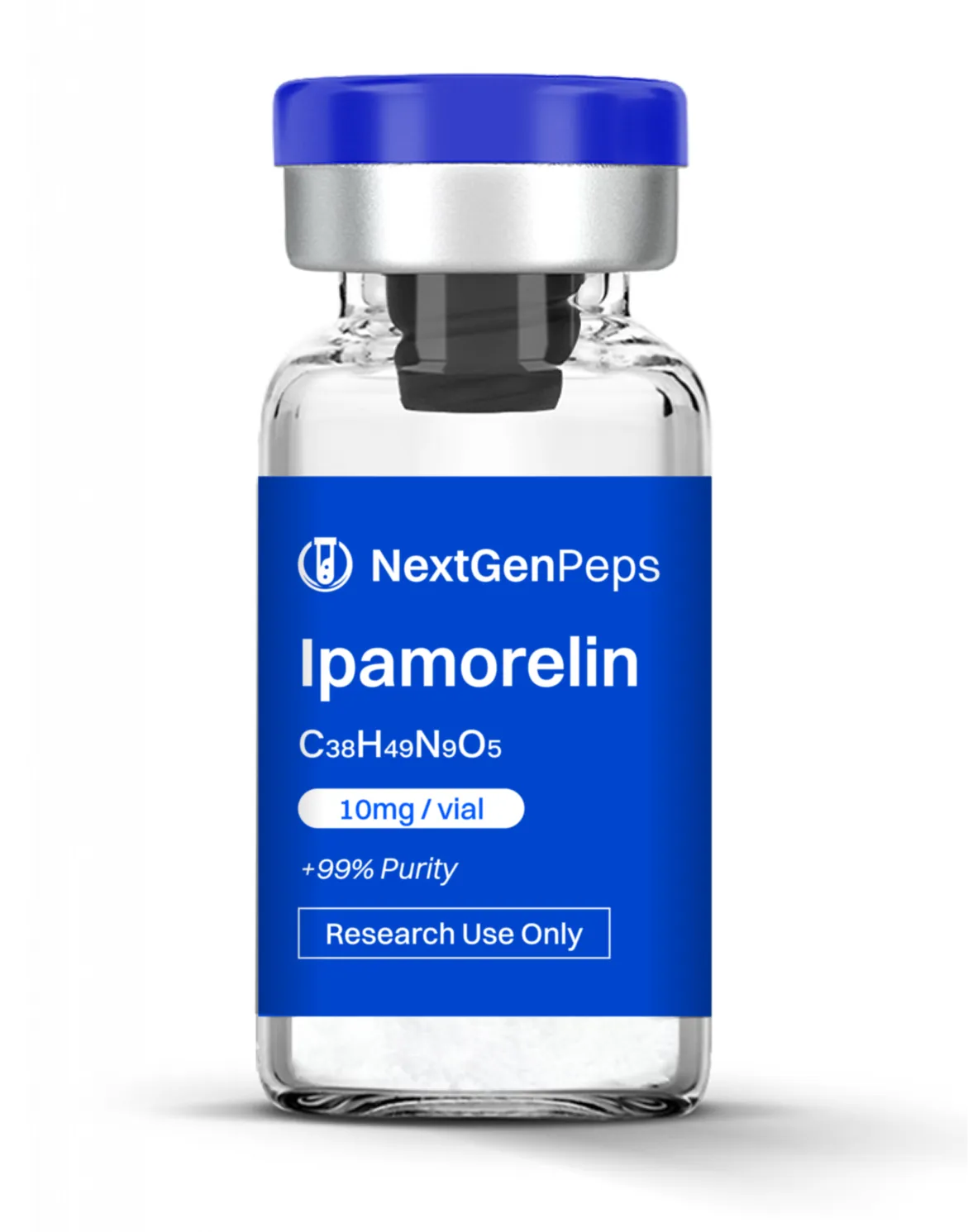




How is Ipamorelin packaged?
Ipamorelin is supplied in the product format and quantity shown for the selected variant. Please inspect the sealed package when it arrives and contact support promptly if the package or labeling appears damaged.
In stock
Selective ghrelin receptor (GHS-R1a) agonist · 10 mg lyophilised research peptide
Ipamorelin research vials, a selective pentapeptide of the growth hormone secretagogue class. Tested for purity, weight and endotoxins, COA published.
Ipamorelin peptide, in brief. Ipamorelin is a synthetic five-amino-acid peptide (Aib-His-D-2Nal-D-Phe-Lys-NH2, CAS 170851-70-4) that activates the ghrelin receptor, GHS-R1a, on pituitary cells and triggers a short pulse of growth hormone release. It is studied because it does this without the rise in ACTH and cortisol seen with older growth hormone-releasing peptides.[1] NextGenPeps supplies Ipamorelin as a lyophilised research peptide, tested for purity and identity on every lot, for laboratory use only.
Growth hormone is not released in a steady stream. The pituitary gland sends it out in pulses, and the timing and size of each pulse are set by signals arriving from elsewhere in the body. Three of those signals matter for this compound.
GHRH (growth hormone-releasing hormone) is made in the hypothalamus and acts on its own receptor on the growth hormone-producing cells of the pituitary, the somatotrophs, telling them to release. Somatostatin, also from the hypothalamus, is the brake: it switches release off between pulses. Ghrelin is the third input. It is produced mainly in the stomach, carries an unusual fatty acid group on one of its amino acids, and acts through a separate receptor on the same pituitary cells, the growth hormone secretagogue receptor type 1a (GHS-R1a), often simply called the ghrelin receptor.
Once released, growth hormone travels to the liver and other tissues, where much of its effect is carried forward by a second messenger, IGF-1. IGF-1 in turn feeds back on the hypothalamus and pituitary to damp the next pulse, which keeps the system self-limiting.
Ipamorelin (development code NNC 26-0161) is a synthetic five-residue peptide built to act at the ghrelin receptor. It was developed in the 1990s from an earlier family of small growth hormone-releasing peptides (GHRPs), and the reason it is studied is selectivity: it triggers growth hormone release with very little effect on the stress-axis hormones ACTH and cortisol, which the earlier peptides in this class also raised.[1] In human pharmacokinetic work its plasma half-life is about two hours, so each exposure produces a single, short-lived growth hormone peak rather than a sustained rise.[2]
NextGenPeps supplies Ipamorelin for laboratory research in vitro and in approved animal models only. It is not approved as a drug anywhere, and is not sold as a supplement, diagnostic or therapeutic agent.
Figure 1. Where Ipamorelin enters the growth hormone axis.
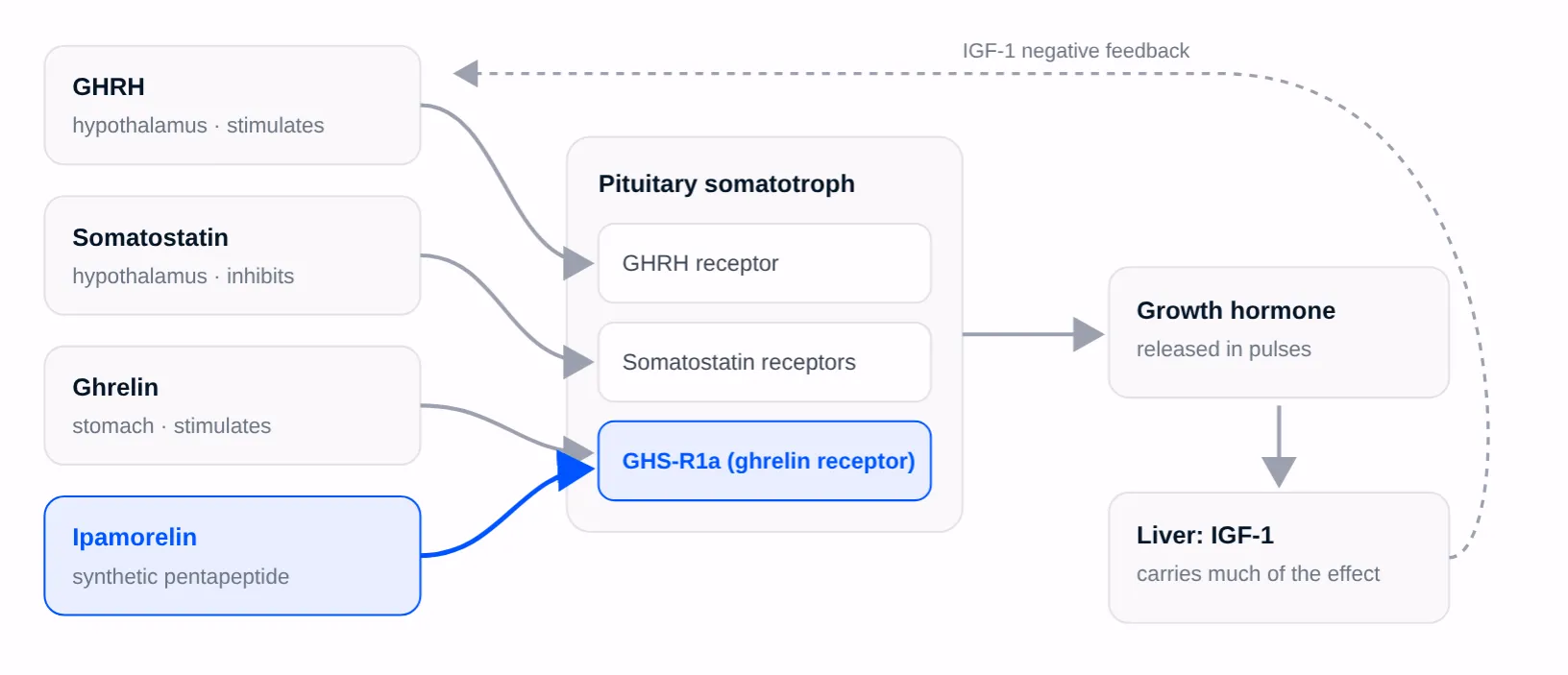
The somatotroph integrates a stimulating signal (GHRH), a braking signal (somatostatin) and a third, independent stimulating input through the ghrelin receptor. Ipamorelin acts only at that third input. Because it works through a different receptor from GHRH, it is often studied alongside GHRH analogues such as CJC-1295 or sermorelin, which act on the first.
The growth hormone-releasing peptides that came before Ipamorelin, GHRP-6 and GHRP-2 among them, were effective at releasing growth hormone but not clean. They also raised ACTH, the pituitary hormone that drives the adrenal stress response, and with it cortisol. For research into the growth hormone axis that is a confounder: an effect seen after dosing could come from growth hormone, from the stress axis, or from both.
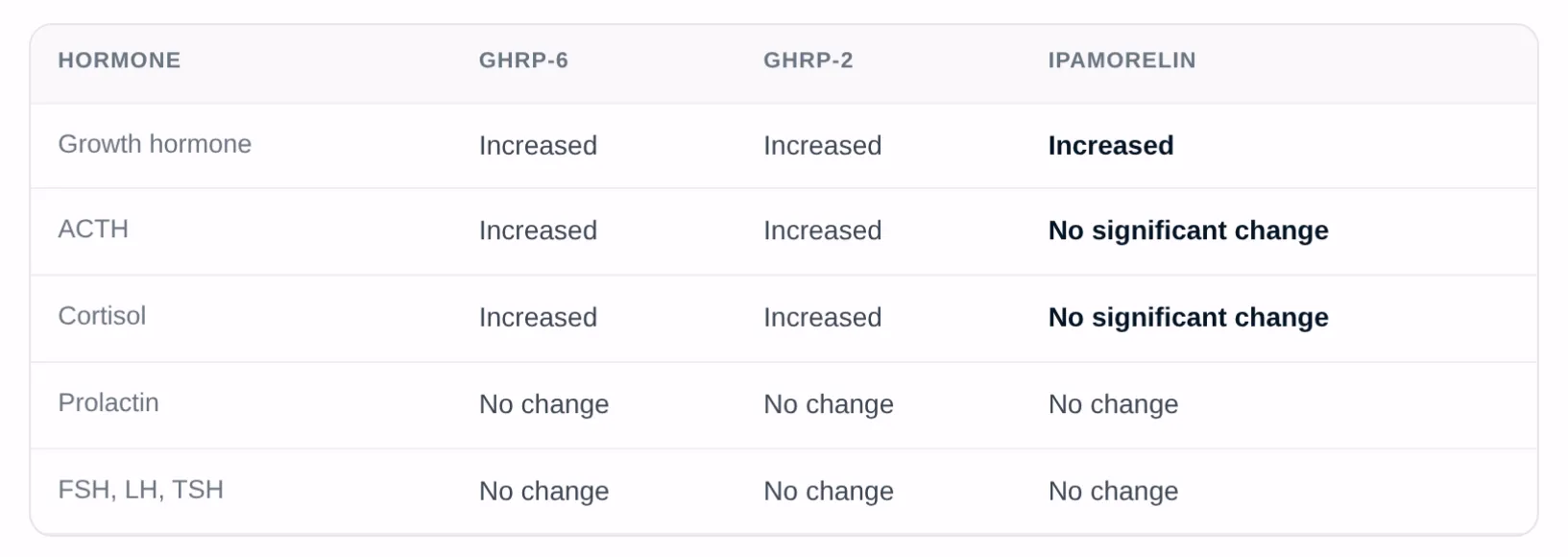
Ipamorelin came out of a medicinal chemistry programme at Novo Nordisk that started from the GHRP-1 sequence; the resulting five-residue peptide lacks GHRP-1's central Ala-Trp pair.[1] In the discovery paper the three peptides were compared side by side in conscious swine. All three released growth hormone, and none of them changed FSH, LH, prolactin or TSH. GHRP-6 and GHRP-2 raised ACTH and cortisol. Ipamorelin did not, even at doses more than 200 times higher than the dose that produced half its maximal growth hormone response, and its ACTH and cortisol readings were comparable to those after stimulation with GHRH itself. The authors described it as the first ghrelin-receptor agonist with a selectivity for growth hormone similar to that of GHRH.[1]
Which pituitary hormones each peptide moved, conscious swine
Growth hormone: GHRP-6 increased; GHRP-2 increased; Ipamorelin increased
ACTH: GHRP-6 increased; GHRP-2 increased; Ipamorelin no significant change
Cortisol: GHRP-6 increased; GHRP-2 increased; Ipamorelin no significant change
Prolactin: GHRP-6 no change; GHRP-2 no change; Ipamorelin no change
FSH, LH, TSH: GHRP-6 no change; GHRP-2 no change; Ipamorelin no change
Summary of the specificity experiments in the discovery paper. For Ipamorelin, the absence of an ACTH and cortisol response held at doses more than 200-fold above its growth hormone ED50.[1] These are single-dose results in one species; whether the same selectivity holds under repeated exposure has not been established in a comparable study.
Ghrelin itself is a 28-residue hormone, but the part that activates the receptor sits at its very start. In the cryo-electron microscopy structure of the ghrelin receptor bound to ghrelin, only the first seven residues fill the binding pocket, and the octanoyl fatty acid on residue 3 tucks into a hydrophobic crevice between the receptor's fourth and fifth transmembrane helices. A salt bridge between two receptor residues, E124 and R283, divides the pocket into two cavities, and one aromatic residue lining the octanoyl crevice, F286, contributes so much that mutating it cut ghrelin's activity more than 250-fold.[3]
The same paper also solved the receptor bound to GHRP-6, the closest relative of Ipamorelin with a deposited structure. GHRP-6 occupies the same pocket as the start of ghrelin, but upside down: its C-terminus is the end that inserts into the helix bundle.[3] That is how a short synthetic peptide with no fatty acid at all can still switch the receptor on: it does not need to mimic ghrelin residue by residue, only to fill the same pocket.
What the structure does and does not show. No structure of Ipamorelin bound to its receptor has been deposited. The binding mode described here is that of ghrelin and GHRP-6, from the same receptor; Ipamorelin is expected to bind in the same pocket because it was derived from that peptide family and the discovery work showed it acts through the same receptor,[1] but the exact pose of each residue is not established.
Compound: Ipamorelin (ipamorelin acetate) · NNC 26-0161
Class: Selective growth hormone secretagogue; synthetic pentapeptide agonist of the ghrelin receptor (GHS-R1a)
Sequence: Aib‑His‑D‑2Nal‑D‑Phe‑Lys‑NH2, with three non-standard residues: Aib (2-aminoisobutyric acid), D-2-naphthylalanine and D-phenylalanine, and an amidated C-terminus
Molecular formula: C38H49N9O5 (free base)
Molecular weight: 711.9 g/mol (free base)
CAS number: 170851-70-4
Appearance: White to off-white lyophilised powder, sealed vial
Purity: By RP-HPLC, identity confirmed by mass spectrometry; the figure for each lot is on its certificate of analysis
Counterion: Typically supplied as the acetate salt; the COA states net peptide content
Solubility: Reconstitutes in bacteriostatic or sterile water; clear, colourless solution
Storage: Lyophilised at or below −20 °C; reconstituted at 2–8 °C, protected from light, freeze-thaw cycles avoided
Plasma half-life: About 2 hours (terminal), in healthy male volunteers after a 15-minute intravenous infusion[2]
Regulatory status: Not approved in any jurisdiction; clinical development ended after phase 2. Listed by the World Anti-Doping Agency as a prohibited growth hormone secretagogue[11]
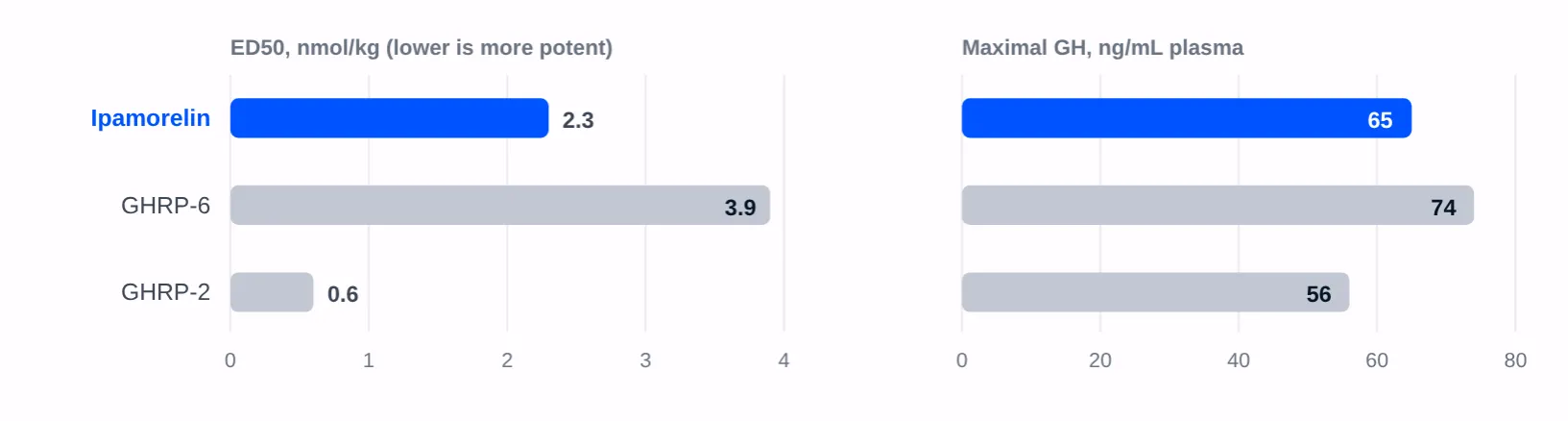
The discovery paper measured Ipamorelin against GHRP-6 in three settings of increasing complexity, and the comparison is more useful than any single number. In primary rat pituitary cells the two were close: Ipamorelin reached half-maximal growth hormone release at 1.3 nmol/L with a maximal response of 85% of GHRP-6, against 2.2 nmol/L for GHRP-6. In anaesthetised rats Ipamorelin was slightly more potent and reached a higher peak. In conscious swine it again sat between the two older peptides, as Figure 2 shows.[1]
Figure 2. Potency and peak growth hormone response, conscious swine.
ED50 is the dose producing half the maximal growth hormone response. GHRP-2 was the most potent of the three but reached the lowest peak; Ipamorelin was more potent than GHRP-6 with a similar peak.[1] Values are from one study, measured under its own conditions, and are not interchangeable with figures from other assays or species.
Ipamorelin is small, carries no lipid chain or albumin-binding group, and is cleared quickly. The one published human pharmacokinetic study gave it as a 15-minute intravenous infusion to healthy male volunteers at five dose levels. Terminal half-life was about two hours, clearance 0.078 L/h/kg and steady-state volume of distribution 0.22 L/kg, a volume close to that of extracellular fluid. Growth hormone peaked about 40 minutes after dosing and then fell away exponentially to negligible levels, a single episode of release rather than a sustained elevation. The modelled concentration giving half-maximal growth hormone stimulation was 214 nmol/L.[2]
~2 h: Terminal plasma half-life, healthy volunteers [2]
0.67 h: Time to peak growth hormone after infusion [2]
0.22 L/kg: Volume of distribution at steady state [2]
214 nmol/L: Concentration for half-maximal GH stimulation [2]
Most of the Ipamorelin literature is preclinical, from the late 1990s and early 2000s, followed by one clinical programme in a gastrointestinal indication. The animal work concentrated on two questions: what sustained growth hormone stimulation does to bone, and whether the ghrelin-receptor link to gut motility could be used to restart a stalled bowel after surgery.
On bone, 15 days of Ipamorelin in adult female rats produced a dose-dependent increase in longitudinal bone growth rate and in body weight.[4] Over 12 weeks, it increased tibial and vertebral bone mineral content as did GHRP-6 and growth hormone itself, but when bone mineral content was corrected for the accompanying gain in body weight the difference disappeared, consistent with bigger bones rather than denser ones.[5] In adult rats given a glucocorticoid, which suppresses bone formation, adding Ipamorelin counteracted the fall in bone formation rate.[6]
On gut motility, Ipamorelin shortened the time to first bowel movement after abdominal surgery in rats, and repeated dosing increased faecal output, food intake and weight gain over 48 hours.[7] In the same surgical model it also accelerated gastric emptying.[8] That rationale went into a phase 2 trial in people recovering from bowel resection, where it did not meet its primary endpoint (Figure 3).[9]
Figure 3. Median time to first tolerated solid meal, phase 2 postoperative ileus trial.
Multicentre, double-blind, placebo-controlled proof-of-concept trial in 114 adults after small or large bowel resection, intravenous dosing twice daily from the day after surgery for up to seven days. The difference of about seven hours favoured Ipamorelin but was not significant, and no secondary efficacy analysis separated from placebo. Treatment-emergent adverse events occurred in 87.5% of the Ipamorelin group and 94.8% of the placebo group.[9]
Eur J Endocrinol 1998 [1]: Discovery and pharmacology: rat pituitary cells, anaesthetised rats, conscious swine. GH release comparable to GHRP-6; ED50 2.3 nmol/kg in swine; no ACTH or cortisol rise at more than 200× that dose.
Pharm Res 1999 [2]: Human PK/PD, healthy male volunteers, 5 dose levels, 15-minute IV infusion. Half-life ~2 h; GH peak at 0.67 h then exponential decline; dose-related response described by an indirect-response model.
Growth Horm IGF Res 1999 [4]: Adult female rats, 18 to 450 µg/day for 15 days. Dose-dependent increase in longitudinal bone growth rate and body weight.
J Endocrinol 2000 [5]: Adult female rats, 0.5 mg/kg/day for 12 weeks, vs GHRP-6 and GH. Higher tibial and vertebral bone mineral content; no difference once corrected for body weight.
Growth Horm IGF Res 2001 [6]: Adult rats on a glucocorticoid. Counteracted the glucocorticoid-induced fall in bone formation rate.
J Pharmacol Exp Ther 2009 [7]: Rat model of postoperative ileus, 0.01 to 1 mg/kg IV. Shorter time to first bowel movement after a single dose; repeated dosing raised faecal output, food intake and weight gain.
J Exp Pharmacol 2012 [8]: Same rat surgical model, gastric endpoint. Accelerated gastric emptying.
Int J Colorectal Dis 2014 [9]: Phase 2, n=114, bowel resection, IV twice daily up to 7 days. Primary endpoint not met: 25.3 h vs 32.6 h, p=0.15; well tolerated.
The published safety record is small, and it should be read for what it is. In the phase 2 trial, 114 people recovering from bowel surgery received Ipamorelin or placebo intravenously for up to seven days. Treatment-emergent adverse events were common in both groups, as expected after major abdominal surgery, and were reported in 87.5% of the Ipamorelin group against 94.8% on placebo; the investigators described Ipamorelin as well tolerated.[9] In the discovery work, Ipamorelin did not raise ACTH or cortisol in swine, the stress-hormone response that limited earlier peptides in the class.[1]
What is missing matters as much. There are no published controlled data on repeated subcutaneous exposure, and when the FDA reviewed Ipamorelin in 2024 it cited that gap, together with the potential for immunogenicity from aggregates and impurities in compounded material.[10] In rodents, sustained exposure increased body weight alongside its effects on bone.[4,5]
These four peptides are often grouped together because all of them end in growth hormone release from the same pituitary cells. They are not interchangeable. Ipamorelin is the only one of the four that works through the ghrelin receptor; the other three are analogues of GHRH and act through the GHRH receptor. That difference is why Ipamorelin and a GHRH analogue are so often studied in combination: each presses a different input on the same cell.
Ipamorelin: receptor Ghrelin receptor (GHS-R1a); length 5 residues; half-life About 2 hours [2]; status Not approved; phase 2 only [9].
Sermorelin: receptor GHRH receptor; length 29 residues, GHRH(1-29); half-life Minutes [14]; status Formerly approved in the US as Geref for paediatric growth hormone deficiency [14].
Tesamorelin: receptor GHRH receptor; length 44 residues, with an N-terminal hexenoyl group; half-life About 26 minutes [13]; status FDA-approved (2010) for one HIV-related indication [13].
CJC-1295 with DAC: receptor GHRH receptor; length GHRH(1-29) analogue with an albumin-binding linker; half-life 5.8 to 8.1 days [12]; status Not approved.
CJC-1295 No DAC: receptor GHRH receptor; length GHRH(1-29) analogue without the linker; half-life Not established in a published human study; status Not approved.
Ipamorelin vs Sermorelin. Neither is "better"; they act on different receptors. Sermorelin reproduces the active N-terminal segment of the body's own GHRH, while Ipamorelin mimics ghrelin's signal.[1,14] Ipamorelin vs Tesamorelin. Tesamorelin is a stabilised full-length GHRH analogue with an approved drug label and a far larger clinical record; Ipamorelin is smaller, ghrelin-receptor-selective and was never approved.[13] CJC-1295 and Ipamorelin. CJC-1295 with DAC binds albumin and stays in circulation for days, raising growth hormone and IGF-1 for a week or more after one dose in healthy adults,[12] the opposite exposure profile to Ipamorelin's two-hour half-life. Products sold as "CJC-1295/Ipamorelin" are blends of two separate peptides, not one compound.
Research suppliers of Ipamorelin vary widely in what they can document, and for a peptide this small the documentation is most of what separates one vial from another. Every NextGenPeps Ipamorelin lot is tested for purity by reverse-phase HPLC and for identity by mass spectrometry at independent laboratories, and the certificate of analysis for each lot is published in the public COA library. Material is supplied as a sealed, lyophilised vial, with the net peptide content stated on the certificate so quantitative work can be corrected for counterion mass.
Verified identity and purity. RP-HPLC purity and mass spectrometry identity on every lot; certificates are published in the public COA library.
US-based fulfilment. Orders ship within 24 hours from the United States, with free US shipping on orders over $150.
Reconstitution supplies. Bacteriostatic water is available alongside, since lyophilised peptides must be reconstituted before use.
Research use only. Ipamorelin is sold strictly for in vitro and approved animal research. It is not for human or veterinary use and is not sold as a drug, supplement or diagnostic.
Format. Supplied as lyophilised powder in a sealed vial, reconstituted with sterile or bacteriostatic water before use. No dosing instructions are supplied and none should be inferred from the studies above, which describe animal and clinical protocols and not research handling.
Storage. Lyophilised material is held at or below −20 °C. Reconstituted solution is held at 2–8 °C and protected from light, with freeze-thaw cycles avoided.
Net peptide content. At 712 g/mol, Ipamorelin is a small molecule by peptide standards, and it carries up to three basic sites that bind counterion. The acetate left from synthesis and purification therefore makes up a meaningful share of vial mass, so quantitative work should use the net peptide content stated on the certificate of analysis rather than the gross fill weight.
Stability by design. Three of the five residues are non-standard: Aib at the N-terminus and two D-amino acids in the middle. Residues like these are poor substrates for the proteases that cut natural peptides, which is part of why such short sequences survive long enough to be studied at all.
Naming. Ipamorelin and NNC 26-0161 are the same molecule. It is distinct from GHRP-2, GHRP-6 and hexarelin, which act at the same receptor but are less selective, and from GHRH analogues such as CJC-1295, sermorelin and tesamorelin, which act on a different receptor.
Anti-doping. Ipamorelin is named on the World Anti-Doping Agency Prohibited List among growth hormone secretagogues, which matters for any laboratory working in sports analysis.[11]
Human data beyond single exposures and one week. The published human record is one pharmacokinetic study of single infusions and one phase 2 trial of up to seven days of intravenous dosing.[2,9] There is no published controlled human study of longer exposure.
Subcutaneous administration. Both human studies used the intravenous route. When the FDA reviewed Ipamorelin for its compounding list in October 2024, it found no safety data for subcutaneous use and raised the possibility of immunogenicity from aggregates and impurities, and it recommended against inclusion.[10]
Selectivity under repeated exposure. The clean ACTH and cortisol profile was shown with single doses in swine.[1] Whether it holds with repeated exposure, or in people, has not been tested head to head against the older peptides.
What bone and weight changes mean. The rat studies show more bone and more body mass, but the increase in bone mineral content tracked the increase in body weight.[5] Whether bone quality changes independently is not settled.
Research Use Only. The statements made within this website have not been evaluated by the US Food and Drug Administration. These materials are not intended to diagnose, treat, cure or prevent any disease and are not intended for human or veterinary use. Studies described on this page are reported for scientific context and are not guidance of any kind.
99.72%
HPLC purity · Tested by Bioregen
Ipamorelin is supplied in the product format and quantity shown for the selected variant. Please inspect the sealed package when it arrives and contact support promptly if the package or labeling appears damaged.
Orders are shipped within the United States via USPS. Transit times are typically 3–7 business days, depending on destination and carrier conditions. Tracking information is provided when available.
Storage requirements are product-specific. Keep Ipamorelin in its original labeled container and follow the product documentation or manufacturer instructions supplied with the order. Contact support if the applicable storage guidance is not available.
Due to the nature of research materials, NextGenPeps orders are final and are not eligible for refunds, returns, or exchanges. Review the shipping and reship policies before ordering.
No. NextGenPeps materials are supplied strictly for laboratory research and development use and are not intended for human or animal consumption, clinical use, diagnostic use, cosmetic use, or dietary use.
Ipamorelin is a selective agonist of the ghrelin (GHSR‐1a) receptor, stimulating GH release from the anterior pituitary and acting on other GHSR‐expressing tissues without significantly increasing cortisol or prolactin at typical research doses.
Compared with GHRP‐2 or GHRP‐6, Ipamorelin shows greater receptor selectivity, reduced off‐target effects (e.g., less impact on cortisol, prolactin, and appetite), and a cleaner GH‐release profile, making it a preferred model for isolated GH secretagogue effects.
Preclinical and translational studies associate Ipamorelin with robust, time‐limited GH pulses, improved lean mass markers under appropriate conditions, enhanced bone formation and mineralization, and potential benefits for recovery from musculoskeletal stress.
Suppliers offer Ipamorelin as 5–10 mg lyophilized vials at ≥99% purity, to be reconstituted with sterile diluent and stored cool and dark, with refrigerated storage after constitution and −20 °C freezing for longer‐term laboratory use.
✓ test purity
✓ 99.11% / 99.50% purity
✓ 99.35% purity
✓ 99.75% purity
✓ 99.78% purity