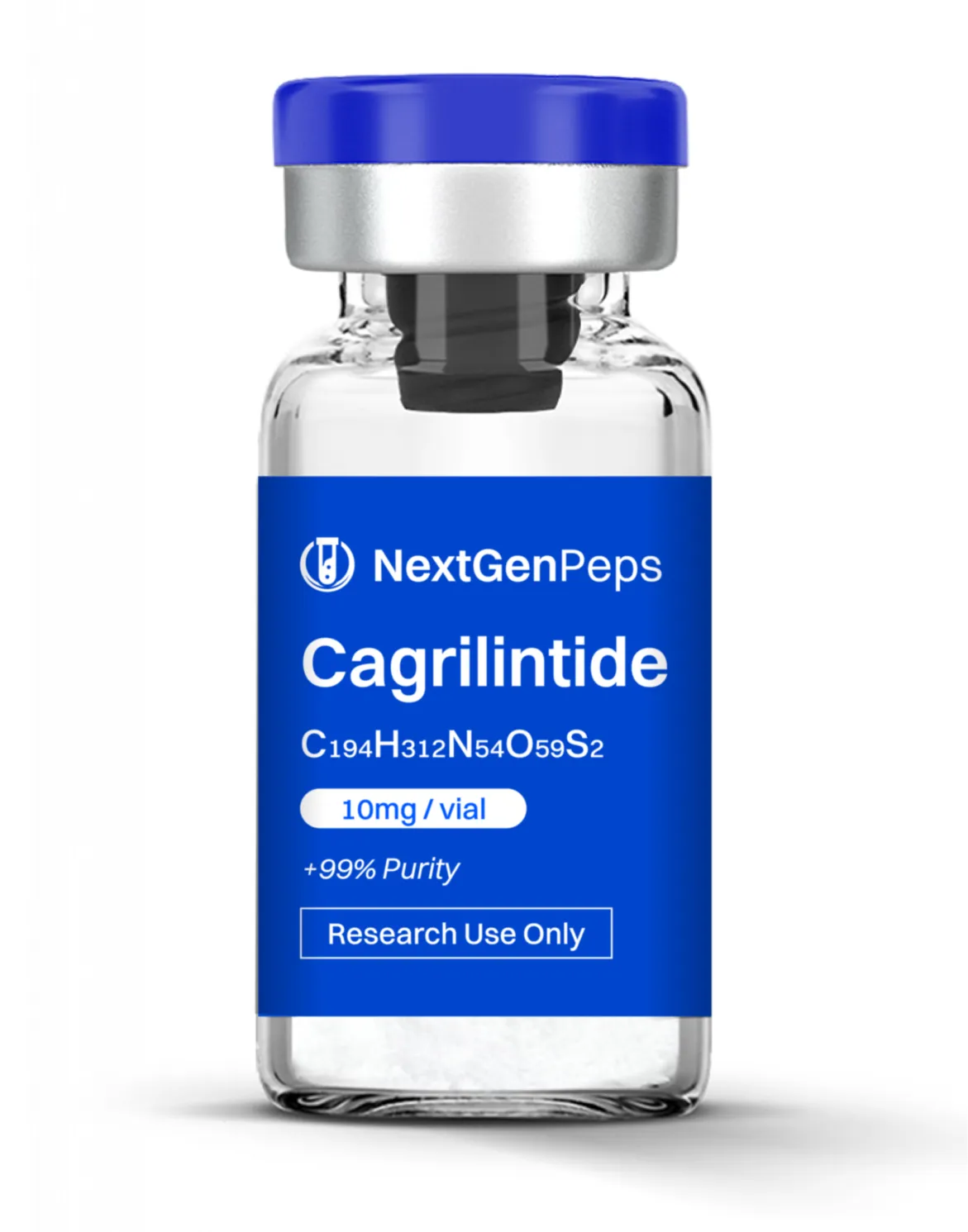




How is Cagrilintide packaged?
Cagrilintide is supplied in the product format and quantity shown for the selected variant. Please inspect the sealed package when it arrives and contact support promptly if the package or labeling appears damaged.
In stock
Cagrilintide 10mg / Vial for laboratory research. View available variants, pricing, and availability. Batch-specific testing documentation is available.
Cagrilintide (CAG) Amylin-Pathway Research Overview
Cagrilintide is a long-acting, research-grade analog of human amylin, engineered to activate amylin and calcitonin-family receptors while resisting aggregation and enzymatic breakdown. It is used to model appetite control, gastric emptying, glucose regulation, and weight loss mechanisms in metabolic research.
Molecular Composition and Mechanistic Profile
Mechanistically, Cagrilintide:
Acts as a non‐selective agonist at amylin receptors (AMY1R, AMY2R, AMY3R) and the calcitonin receptor (CTR), all of which are CTR/RAMP heterodimers in the calcitonin receptor family.
Engages brainstem and hypothalamic circuits (notably in the area postrema and related nuclei) to decrease food intake, increase satiety, slow gastric emptying, and ultimately lower body weight in animal and human studies.
Shows distinct binding dynamics versus native amylin and salmon calcitonin, with cryo‐EM data indicating unique conformational effects on CTR/RAMP complexes that may underlie its robust and durable anorectic activity.
These features make Cagrilintide a key tool for dissecting long‐acting amylin‐pathway pharmacology in obesity and diabetes research.
Integrated Research Applications
Cagrilintide is investigated across several metabolic and endocrine research areas:
Obesity and energy balance: Clinical and preclinical studies show substantial body‐weight reductions and decreased calorie intake when Cagrilintide is administered alone.
Combination incretin–amylin strategies: Trials combining Cagrilintide with GLP‐1 analogues (e.g., semaglutide, in “CagriSema” constructs) demonstrate synergistic weight loss and improved glycemic control compared to either agent alone.
Type 2 diabetes and glycemic control: Research explores its effects on fasting glucose, HbA1c, and post‐prandial glycemia via slowed gastric emptying, reduced food intake, and possible direct pancreatic/islet effects.
Liver and cardiovascular markers: Cagrilintide is also studied for impacts on liver fat, cardiovascular risk markers, and systemic metabolic signaling, including lipid profiles.
Because it is long‐acting and aggregation‐resistant, Cagrilintide enables chronic dosing protocols that more closely mimic prospective therapeutic scenarios.
Analytical Validation, Formulation, and Storage
Research suppliers provide Cagrilintide as a lyophilized, white to off‐white powder (typically 10 mg per vial) intended for reconstitution prior to experimental use. Key quality and handling characteristics include:
Purity: High (often ≥98–99%) verified by HPLC and complementary analytical methods.
Identity: Confirmed by mass spectrometry and peptide mapping consistent with the C194H312N54O59S2 composition and amylin‐analogue sequence.
Solubility: Slightly soluble in DMSO (≈0.1–1 mg/mL) and sparingly soluble in aqueous buffers such as PBS; formulation often requires careful pH and solvent selection.
Product care, matching your house style:
Store vials in a cool, dry place away from light while lyophilized.
After constitution with appropriate lab‐grade diluent, refrigerate the solution; for longer‐term storage, freezing at approximately −20 °C is recommended to preserve peptide integrity.
NextGenPeps supplies cagrilintide as a high-purity research compound intended exclusively for laboratory use. It is not approved for therapeutic, diagnostic, or dietary purposes and is not intended for human administration or self-experimentation.
99.46%
HPLC purity · Tested by Bioregen
Cagrilintide is supplied in the product format and quantity shown for the selected variant. Please inspect the sealed package when it arrives and contact support promptly if the package or labeling appears damaged.
Orders are shipped within the United States via USPS. Transit times are typically 3–7 business days, depending on destination and carrier conditions. Tracking information is provided when available.
Storage requirements are product-specific. Keep Cagrilintide in its original labeled container and follow the product documentation or manufacturer instructions supplied with the order. Contact support if the applicable storage guidance is not available.
Due to the nature of research materials, NextGenPeps orders are final and are not eligible for refunds, returns, or exchanges. Review the shipping and reship policies before ordering.
No. NextGenPeps materials are supplied strictly for laboratory research and development use and are not intended for human or animal consumption, clinical use, diagnostic use, cosmetic use, or dietary use.
CAG is a long‐acting agonist at amylin receptors (AMY1R, AMY2R, AMY3R) and the calcitonin receptor (CTR), all part of the calcitonin receptor family, giving it broad amylin‐like activity in brain and peripheral tissues.
By activating brain amylin receptors (especially in the area postrema and other hindbrain regions), CAG reduces meal size and frequency, slows gastric emptying, and shifts energy balance toward weight loss in rodent and human studies.
GLP‐1 agonists and amylin analogues act via partially distinct but complementary pathways; combined administration yields greater weight loss and metabolic improvements than either alone, making CAG a core component of dual‐hormone obesity models.
Research suppliers ship CAG as freeze‐dried powder (e.g., 10 mg vials) for reconstitution with lab‐grade solvent, stored cool and protected from light, refrigerated after constitution, and frozen at −20 °C for long‐term experimental use.
✓ test purity
✓ 99.11% / 99.50% purity
✓ 99.35% purity
✓ 99.75% purity
✓ 99.78% purity