BPC-157: What the Research Actually Shows (2026 Review)
A research review of BPC-157: its structure, the mechanisms proposed in cell and animal studies, what pharmacokinetic work in rats and dogs found, how thin the human data still are, and where its regulatory status stands as of October 2026.
10 min readBy NextGenPeps
On this page15 sections
- Key points
- What is BPC-157?
- Proposed mechanisms from preclinical studies
- VEGFR2, Akt and eNOS: blood vessel growth
- FAK–paxillin: cell migration and survival
- Growth hormone receptor and JAK2
- Nitric oxide system and early-response genes
- What animal studies report
- Pharmacokinetics in rats and dogs
- What we know in humans
- Open safety questions
- Regulatory status as of October 2026
- What the field still needs
- Research use notice
- References
BPC-157 is one of the most discussed research peptides of the last decade, and one of the least understood in humans. Dozens of cell and animal studies describe effects on blood vessels, tendons, the gut and wound healing. Controlled human trials, however, have never been completed. This review summarizes what the published literature reports, where the evidence is strong, where it is thin, and how the regulatory picture changed in 2026.
Key points
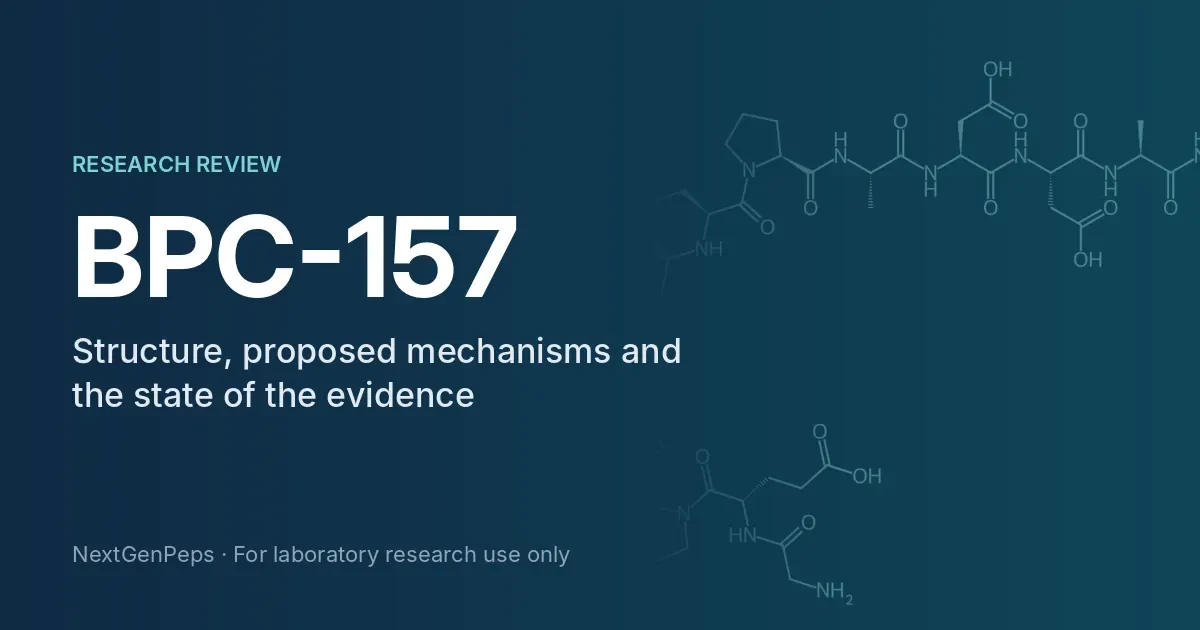
BPC-157 is a synthetic 15-amino-acid peptide (GEPPPGKPADDAGLV) derived from a protein found in human gastric juice.
Cell and rodent studies link it to VEGFR2 signalling, nitric oxide, FAK–paxillin activation and growth hormone receptor expression.
In rats and dogs, intact BPC-157 is cleared within minutes and broken down into amino acids.
Human data are limited to a few small, uncontrolled reports. No randomized controlled trial has been published.
BPC-157 is not FDA-approved. An FDA advisory committee voted 8–6 in July 2026 to recommend it for the compounding bulks list, but the FDA has not acted on that vote. WADA prohibits it in sport.
What is BPC-157?
BPC stands for Body Protection Compound. The peptide was first described in 1993 by Predrag Sikirić and colleagues at the University of Zagreb as a fragment of a larger protective protein isolated from human gastric juice. The material used in research today is made by solid-phase synthesis.
Sequence: Gly-Glu-Pro-Pro-Pro-Gly-Lys-Pro-Ala-Asp-Asp-Ala-Gly-Leu-Val (GEPPPGKPADDAGLV)
Molecular formula: C62H98N16O22
Molecular weight: about 1419.5 g/mol (monoisotopic mass 1418.70 Da)
Structure: linear peptide with a free N-terminal amine and C-terminal acid; contains a Pro-Pro-Pro triplet at positions 3–5 and a fourth proline at position 8
Researchers often point to the proline-rich N-terminal region to explain why the peptide is reported to be unusually stable in water and gastric juice compared with most short peptides. That stability claim comes largely from the originating laboratory and has not been characterized as thoroughly as it would be for an approved drug.
Proposed mechanisms from preclinical studies
No single receptor for BPC-157 has been identified. Instead, studies describe effects on several signalling pathways. All of the findings below come from cell cultures or animal models.
VEGFR2, Akt and eNOS: blood vessel growth
A 2017 study in the Journal of Molecular Medicine found that BPC-157 increased expression of the VEGF receptor VEGFR2 in endothelial cells and in ischemic rat muscle, without raising VEGF-A itself. It also promoted VEGFR2 internalization and activated the downstream Akt–eNOS pathway, which produces nitric oxide. In a rat hind-limb ischemia model, treated animals recovered blood flow faster and showed more new vessels. Blocking receptor internalization with dynasore abolished these effects (Hsieh et al., 2017).
FAK–paxillin: cell migration and survival
Work on rat Achilles tendon fibroblasts showed that BPC-157 increased cell outgrowth from tendon explants, cell spreading and migration, and survival under oxidative stress. These changes were accompanied by dose-dependent phosphorylation of focal adhesion kinase (FAK) and paxillin, two proteins that link the cell skeleton to its surroundings. The peptide did not directly increase fibroblast proliferation (Chang et al., 2011).
Growth hormone receptor and JAK2
A follow-up microarray study by the same group found the growth hormone receptor among the most strongly up-regulated genes in BPC-157-treated tendon fibroblasts. Receptor levels rose with dose and time, and adding growth hormone to treated cells increased proliferation and activated the downstream kinase JAK2 (Chang et al., 2014).
Nitric oxide system and early-response genes
The Zagreb group has published extensively on interactions between BPC-157 and the nitric oxide system, reporting that it counteracts effects of both NOS inhibitors such as L-NAME and NO precursors in rodent models. Separately, a 2007 study of the peptide under the code PL 14736 linked improved granulation tissue and collagen organization in rat wounds to induction of the early-response gene EGR-1 and its co-repressor NAB2 (Tkalčević et al., 2007).
These pathways are plausible and internally consistent, but each rests on a small number of studies, often from one or two laboratories. None has been confirmed in human tissue.
What animal studies report
Most of the BPC-157 literature consists of rat and mouse studies. Reported outcomes include faster healing of transected Achilles tendons (Starešinić et al., 2003), protection against NSAID- and alcohol-induced gastric and liver lesions, improved muscle and ligament repair, and effects in models of fistulas, burns and drug toxicity.
A 2025 systematic review in HSS Journal screened 544 abstracts and included 39 studies published between 1993 and 2024 on orthopaedic and sports-medicine uses. Nearly all were preclinical, covering muscle, tendon, ligament and bone models, and only one involved human patients. The authors concluded that the preclinical signals are encouraging but that clinical evidence is insufficient to support use (Vasireddi et al., 2025).
Two caveats apply to this body of work. First, a large share of the studies come from the research group that discovered the peptide, and independent replication is limited. Second, rodent healing models often fail to predict results in humans.
Pharmacokinetics in rats and dogs
The most complete pharmacokinetic study to date used LC-MS/MS and radiolabelled peptide in Sprague-Dawley rats and beagle dogs (He et al., 2022).
Measure | Rat | Dog |
|---|---|---|
Elimination half-life after IV dose | 15.2 min | 5.3 min |
Time to peak after IM injection | about 3 min | 6–9 min |
Absolute bioavailability after IM injection | 14–19% | 45–51% |
Intact peptide was undetectable four hours after dosing. Exposure scaled linearly with dose, and repeated daily dosing for seven days changed the parameters little. Labelled material concentrated in the kidney, liver and stomach wall and was lowest in the brain and fat. BPC-157 was broken down step by step into six small fragments and free amino acids, including proline, and was excreted mainly in urine with some biliary excretion. The authors noted that the short half-life is a key obstacle for any future drug development.
What we know in humans
Human evidence is sparse and low quality:
Early 2000s: a phase I safety study of PL 14736 in healthy volunteers, developed for inflammatory bowel disease, reported the peptide was well tolerated. Detailed results were never fully published.
2015: a phase I trial of an oral formulation was registered as NCT02637284. It was later cancelled and no results were posted.
2021: a retrospective survey of 12 patients with knee pain who had received intra-articular injections reported subjective improvement in most. There was no control group and no validated outcome measure (Lee & Padgett, 2021).
2025: a pilot safety study gave intravenous infusions to two healthy adults and reported no adverse effects (Lee & Burgess, 2025).
Reviewers on both sides of the debate agree on the core problem: this documentation falls well short of what is needed to establish safety or efficacy, and independent randomized trials have not been done (Józwiak et al., 2025).
Open safety questions
No toxic dose has been established in animal studies, and short-term toxicity studies in rats and dogs reported no obvious changes. Long-term and reproductive toxicity have not been studied.
Because BPC-157 appears to promote new blood vessel growth, reviewers have raised the theoretical concern that it could support tumor growth. This has not been tested directly.
Effects on nitric oxide could, in principle, cut both ways, since excess NO can form damaging reactive species.
At the July 2026 FDA advisory meeting, agency reviewers said BPC-157 is not well characterized, that quality standards cannot yet be set, and that the FDA had received three adverse event reports whose cause could not be determined (RAPS).
Regulatory status as of October 2026
BPC-157 is not approved by the FDA or any other major regulator for any use. Its status for pharmacy compounding has moved quickly this year:
2023: the FDA placed BPC-157 in Category 2, substances that raise significant safety concerns, which barred 503A pharmacies from compounding it.
April 2026: the FDA announced it would remove BPC-157 and 11 other peptides from Category 2 and refer them to its Pharmacy Compounding Advisory Committee. Removal did not make them eligible for compounding (Frier Levitt).
23 July 2026: the committee voted 8–6, with one abstention, to recommend adding BPC-157 to the 503A bulks list, against the recommendation of FDA staff. The vote is advisory (ABC News).
October 2026: an FDA interim access policy for compounding certain peptides went to White House budget office review on 14 October. Its text and covered substances are not yet public, and BPC-157 has not been added to the bulks list (Mondaq).
Sport: the 2026 WADA Prohibited List names BPC-157 under S0, non-approved substances, which are banned at all times.
What the field still needs
Independent replication of the core animal findings outside the originating laboratory.
Identification of a primary molecular target or receptor.
Human pharmacokinetic data and validated analytical standards for identity and purity.
Long-term toxicity studies, including any effect on tumor growth.
Randomized, controlled clinical trials with predefined outcomes.
Research use notice
This article summarizes published research for educational purposes. It is not medical advice. NextGenPeps supplies BPC-157 strictly for laboratory research use in vitro or in approved animal models. It is not intended for human or animal consumption, or for diagnostic, therapeutic, cosmetic or dietary use.
References
Sikirić P, et al. A new gastric juice peptide, BPC. An overview of the stomach-stress-organoprotection hypothesis and beneficial effects of BPC. J Physiol Paris. 1993;87(5):313–327.
Starešinić M, et al. Gastric pentadecapeptide BPC 157 accelerates healing of transected rat Achilles tendon and in vitro stimulates tendocytes growth. J Orthop Res. 2003;21(6):976–983.
Tkalčević VI, et al. Enhancement by PL 14736 of granulation and collagen organization in healing wounds and the potential role of egr-1 expression. Eur J Pharmacol. 2007;570(1–3):212–221.
Chang CH, et al. The promoting effect of pentadecapeptide BPC 157 on tendon healing involves tendon outgrowth, cell survival, and cell migration. J Appl Physiol. 2011;110(3):774–780. doi:10.1152/japplphysiol.00945.2010
Chang CH, et al. Pentadecapeptide BPC 157 enhances the growth hormone receptor expression in tendon fibroblasts. Molecules. 2014;19(11):19066–19077. doi:10.3390/molecules191119066
Hsieh MJ, et al. Therapeutic potential of pro-angiogenic BPC157 is associated with VEGFR2 activation and up-regulation. J Mol Med. 2017;95(3):323–333. doi:10.1007/s00109-016-1488-y
Lee E, Padgett B. Intra-articular injection of BPC 157 for multiple types of knee pain. Altern Ther Health Med. 2021;27(4):8–13. PubMed 34324435
He L, et al. Pharmacokinetics, distribution, metabolism, and excretion of body-protective compound 157, a potential drug for treating various wounds, in rats and dogs. Front Pharmacol. 2022;13:1026182. doi:10.3389/fphar.2022.1026182
Józwiak M, et al. Multifunctionality and possible medical application of the BPC 157 peptide: literature and patent review. Pharmaceuticals. 2025;18(2):185. doi:10.3390/ph18020185
Józwiak M, et al. Reply to Sikiric et al. Pharmaceuticals. 2025;18(10):1451. doi:10.3390/ph18101451
Vasireddi N, et al. Emerging use of BPC-157 in orthopaedic sports medicine: a systematic review. HSS J. 2025. doi:10.1177/15563316251355551
Lee E, Burgess K. Safety of intravenous infusion of BPC157 in humans: a pilot study. Altern Ther Health Med. 2025.
World Anti-Doping Agency. 2026 Prohibited List, section S0. wada-ama.org
Written by NextGenPeps
The NextGenPeps editorial team summarizes published peptide research for laboratory audiences. Articles are educational, cite their sources, and do not describe any product for human use.
More articles →Research Use Only: this article describes laboratory research. Nothing here is dosing guidance, and these materials are not intended for human use.